Truth is Real, I Killed It Myself
I was dumb enough to argue on discord again.
The following article is going to read as unkind, and unfortunately this feels unavoidable because the facts of what's being presented are simply unkind on its face. The following is a discussion of the very bones of reality, of the nature of empathy itself, and no matter how hard you try, you will leave something of yourself on the table when you discuss that. And what's been left? We'll see.
The discussion got around to my thesis statement of Politics As a Game of Stories. One in which objective truth has been abandoned and it is necessary to engage in someone else's truth (or manufacture your own more compelling truth) to convince people of anything. This is the core premise of empathy first politics, understanding someone else's perspective, regardless of how insane. Reality has been shattered, and we must build our new movement across the million fractured pieces, scattered over the internet and its rabbit holes.
Quants, are the kind of people still arguing for some form of objective truth. They are often moderates. They would call for me to be in a padded room for this (This one already has). The kind of people who watch their favourite streamer read studies to them. Politics by Quant is politics judged on the numbers of a graph over the stories of people. This interaction has been highlighted not out of ill will, but because I think it represents the very core of this worldview.
The response from my interlocutor, let's call him The Quant, is the reason this article exists.
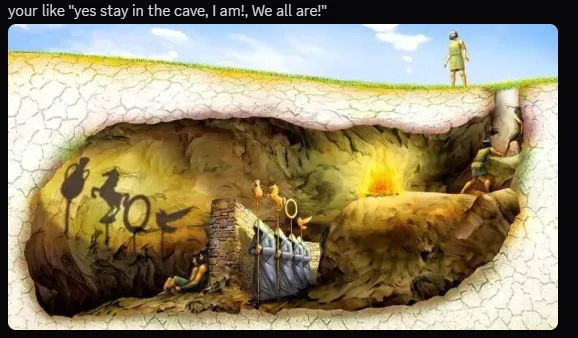
First: Describing Plato's Cave
Plato's Cave, or the Allegory of the Cave is an ancient thought experiment in Republic, a socratic dialogue written around 375 BC. Imagine a cave where people are imprisoned from childhood, their legs and neck are fixed in chains. They can only look at the cave wall, not even each other or themselves. Behind them is a fire, and the only thing they can see is the shadows it casts on the cave wall, people bring objects back and forth to cast different shapes, and the prisoners believe the sounds those people make come from the shadows. Socrates supposes the shadows are their reality, they have never known anything else.
One of the most interesting questions is, how do you convince someone to leave?
Plato never outright answers this, but Socrates discusses what happens after you force someone to leave the cave. He suggests that the returning cave dwellers eyes would adjust to the outside sunlight, his reality would change, and when he returned he would be blind in the caves darkness. The cave dwellers would be able to tell, and would conclude that leaving the cave blinds them, would think that the returning dweller has been driven insane by the experience, and would attempt to kill anyone who dragged them into the light.
The allegory is related to Plato's theory of Forms, in which the ideas or "forms" are the building blocks of our reality, in contrast to our physical sensations. It is one of the most famous and fundamental works on the idea of truth as a subjective experience. Knowledge of the "Forms" constitutes real knowledge, and those who have it must return to the cave, sit with the dwellers, and share in their horrors.
The solution from my perspective, is to engage with the dwellers reality as it is, to convince them there are more caves, and more shadows, to first build the idea that there may be more than just this reality, and eventually change the "Forms". If reality is a story we tell ourselves then slowly, with understanding, iteration after iteration, we can rewrite it to everyone's benefit. The returning dweller must give his eyes time to readjust. Bridge the gap. Engage with feeling if fact is dead.
Quant's Solution
"That's not empathy, It's moral cowardice. Things are real, people are wrong, sorry."
If the dwellers refuse to believe you? If they choose the only world they know? Tell them they are stupid and move on with your life. This is empathy to the Quant. Anything else would be cowardice.
If I were to steelman this position, I think I would have to deconstruct the allegory itself. What if it took place in the modern day? What if I could show a picture of the outside. What If I made my own shapes in the shadows and showed them how they were constructed? What if I showed them proof? The point of course, is that there is no proof that would convince them, because they have no reason to trust you over a lifetime of personal experience. "Your numbers are all lies," "your photos are all fake and don't show what you say they do," "You might be able to make your own shadows on the wall, but that doesn't mean the other shadows aren't alive." One could draw plenty of parallels to a conservative movement that can watch a woman get shot driving away from an ICE officer only to say she was trying to hit him. We know who's dwelling in the cave, and raw evidence is not enough to pull them out.
The Quant's Idea Of Reality is More Important Than Reality
Plato's cave, a work built on subjectivity, built on examining the flaws of the basic sensations that define reality itself, is used to justify the objective truth. An allegory constructed around the impossibility of describing another reality, or forcing someone to experience another reality, is solved by simply telling them the truth. The ultimate irony is, to attempt to drag the other dwellers into the sun is to ignore every scholarly article and response, from Plato & Socrates until now. To use this example as if it were ever in favour of objectivity, is to abandon 2000 years of its "objective" history.
Reality is dead, The Quant killed it himself.
The idea of objective truth and its meaning is subjective in itself. Our quant and theocratic fascists like Matt Walsh both believe in objective truth, and yet have wildly different conclusions drawn up by wildly different numbers. To both of them, the other is objectively wrong because they have the incorrect numbers.
To deradicalize someone is to present them with the stories of who they have hurt. In the Nazi deradicalization efforts this proved particularly effective. The best way to prove to a Nazi that Jews are human was to present them not with facts and graphs, or data about their phrenology, but with a human being. When presented with the stories of their oppression, the humanity of the oppressed becomes undeniable.
To be a quant is to argue about facts neither of you will acknowledge as correct by the end of the discussion. It is to show the dwellers of Plato's cave a photo and then call them stupid when they bite you for trying to remove them. It is to reject their story to engage with the idea of truth, the notion of a reality that can never be objectively defined. The pursuit is all that matters. Your eyes must not get time to adjust to the darkness of the cave, lest you risk becoming a dweller again.
Thanks for reading! I recently created a matrix at https://matrix.to/#/#chakkieblog:matrix.org
We discuss the world and what to do about it!